Gordon Syron
b. 1941
- Region
- South-East Australia
- Community
- Nabiac
- Language
- Birpi (Biripi); Worimi
Region: South-East Australia · Community: Nabiac · Language: Birpi (Biripi); Worimi
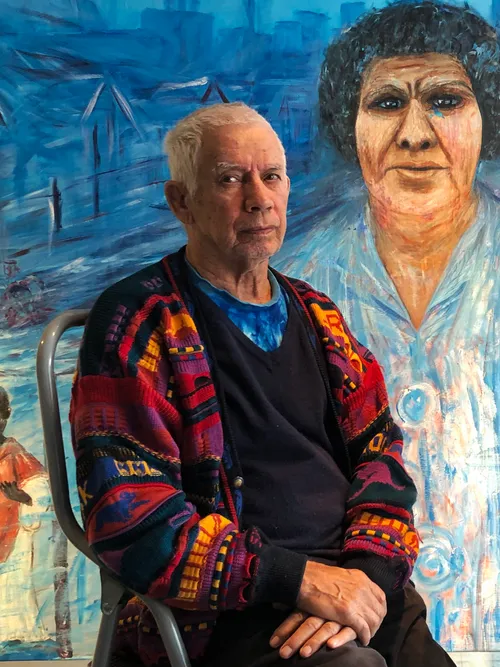
Acknowledged as the pioneer of urban aboriginal art, Gordon Syron had an auspicious start in life, on his family’s dairy farm in mid-north NSW. It was hard work, he recalls, but there was always enough food on the table. However, things took a dramatic turn when he was sentenced to life in prison for murder, after a land rights dispute concerning inheritance of the family farmlands. It was in jail that he began to teach himself to paint, encouraged by other inmates including a master forger. In 1978 he painted Judgment by His Peers, his most controversial work and to Gordon, a work that defined his ongoing commitment to justice, self-determination and reconciliation for aboriginal people. The painting of a white prisoner facing a court room of black judge and jury, relates to his own case where his request to be ‘judged by peers’ (as the law so decrees), and for an aboriginal juror to be included on the panel was rejected. This painting has been very widely documented and exhibited, including in Parliament House, Canberra. After ten years, Gordon’s model behaviour led to early release from prison.
Gordon Syron has gone on to paint many iconic works, all of which have a political message. Even his more recent wildflower series (started in 2002), inspired by memories of his childhood days, when he could lean down from his horse and gather armfuls of resplendent blooms, carries the sadness and anger about this once beautiful area of land now ruined by mining companies. Tiny black fairies dance throughout the beautiful painted flowers, “but they are all gone now,” he says.
His more direct political paintings resound with a savage satire, giving urgent voice to an alternative perspective on issues of the day, the history of European invasion and the colonization and violent subjugation of aboriginal people. Often suffused with blue, a color conspicuously absent from the indigenous tradition, his radical message also conveys a subtle call for reconciliation between black and white.
Alongside his prolific artmaking, Gordon became a strong voice in the community for aboriginal causes and for substantial change. He was co-founder of Eora College in Redfern, Sydney, where he also taught art. (The college, now run by Tafe, still educates and inspires the inner-city aboriginal community). He presided for many years on the Deaths in Custody Committee, addressing the drastic over representation and mistreatment of aboriginal people in Australian prisons. He and his wife Elaine, began the Blackfella Dreaming Gallery (1998-2005)) which has now become a huge and varied collection of aboriginal art, described by Djon Mundine as the best collection in Australia.
Over his long career, Gordon has eschewed the privately-owned gallery system, criticizing the large sums made by art dealers in comparison to the smaller earnings of the artists, who often live far from the clamor of the art world. This has not left his art unseen however, as many institutions and public galleries can affirm, including two retrospectives at the Australian Museum, who currently hold much of his collection.
Profile Author: Sophie Baker
Exhibitions
- Current Hang1 October – 31 October 2026
- Syron's WarApril 2026
- Black Art White Walls2014 – 2016

Gordon Syron
Invasion Day, 2005
oil on canvas
173 cm x 173.5 cm
Price on application — enquire

Gordon Syron
Untitled (Mimi Spirits), 2005
oil on canvas
122 x 128 cm
Price on application — enquire

Gordon Syron
The Waratah Forest, 2011
oil on canvas
205 x 140 cm
Price on application — enquire

Gordon Syron
Original Diggers in France 1917, 2008
oil on canvas
91.5 x 76 cm
$18,000

Gordon Syron
Enlist Here, 2007
oil on canvas
110 x 80 cm
$18,000

Gordon Syron
Hanging Gums, 2012
oil on canvas
120 x 90 cm
$10,000

Gordon Syron
The Black Bastards are Coming, 2008
oil on canvas
89 x 110 cm
$8,000

Gordon Syron
Where the Wildflowers Once Grew, c. 2005
oil on linen
76 x 100 cm
$6,000

Gordon Syron
Black Ballerina, 2002
oil on canvas
58 x 41 cm ; 84 x 67 cm frame
$6,000

Gordon Syron
Women's Circle, 2015
oil on canvas
75 x 104 cm
$6,000

Gordon Syron
Black Ballerina, 2012
oil on linen
61 x 76.5 cm
$5,000

Gordon Syron
The Narcissistic Red Coat, 2002
oil on paper
57.5 x 40 cm; 77 x 59 cm frame
$4,500

Gordon Syron
Head Poisoner, 2008
oil on canvas board
76 x 51 cm; 79.5 x 54 cm frame
$4,500

Gordon Syron
The Last Bottle, 2003
oil on canvas board
45.5 x 35 cm
$3,000

Gordon Syron
Minimbah, 2000
oil on canvas
47 x 54 cm (irreg); 52 x 58.5 frame
$3,000

Gordon Syron
The Gender of God, 2009
oil on canvas
50 x 45 cm; 53 x 48.5 cm frame
$2,750

Gordon Syron
The Poisoning of the Waterholes, 2000
oil on canvas
49 x 31 cm; 53 x 35.5 cm frame
$2,200

Gordon Syron
Red coats at the waterhole, 2002
oil on canvas
49 x 31 cm; 52.5 x 37 cm frame
$2,200