Willy Tjungurrayi
AAMI artistc.1930 – 2018
- Region
- Western Desert
- Community
- Kintore (Walungurru)
- Language
- Pintupi
Region: Western Desert · Community: Kintore (Walungurru) · Language: Pintupi
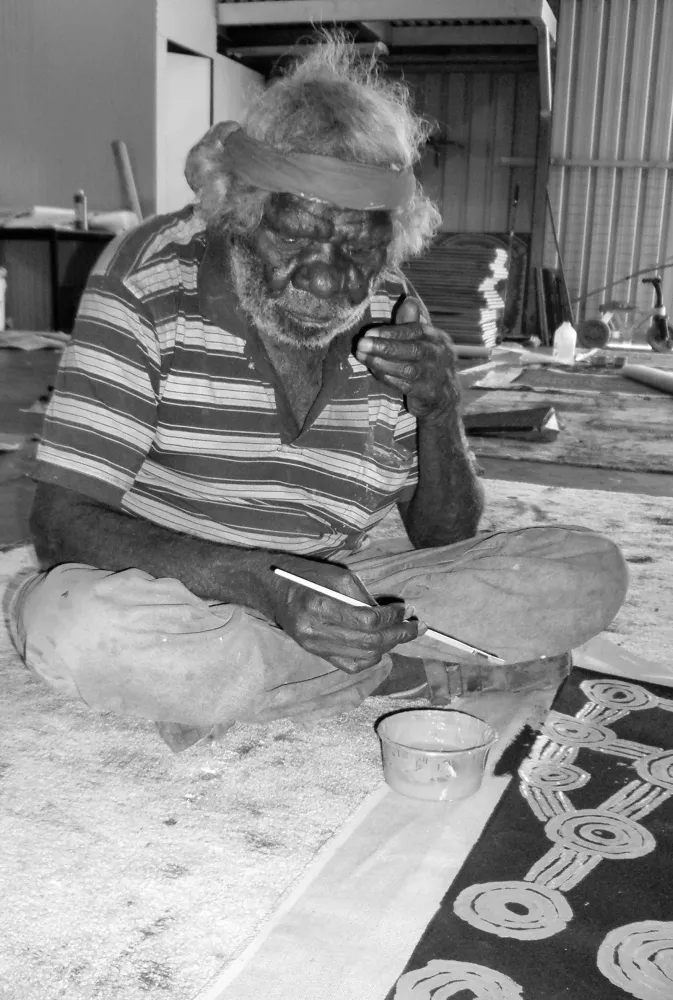
Despite his reputation as a major figure in the central desert art movement Willy Tjungurrayi did not move to Papunya from his birthplace, Patjanta, until his late 30’s, several years after Geoff Bardon had departed the community. He came in from the desert as part of a large group led by Charlie Tarawa and his camels and was trucked across to Papunya with most of the other residents of Haasts Bluff when that community was disbanded. Willy Tjungurrayi only began painting for Papunya Tula in 1976 after returning from a trip to the western desert sponsored by the Australian Institute of Aboriginal studies. He moved during the 1970’s between a number of western desert communities including Yayayi, Waruwiya and Ilyilingi finally settling in Kintore where he lived from the early 1980’s until 2003. One of three brothers born of the same father of whom Yala Yala Gibbs is the eldest and George Ward is the youngest, Willy raised Joseph Jurra Tjapaltjarri while living at Kintore within this close family group. Here he continued painting the delicate classic Pintupi grids of interconnecting rondels and Dreaming tracks that dominated his works throughout much of the 1980’s and 1990’s. These early to mid career paintings are more cartographically detailed and ethnographically specific than those he produced from 2000 onward and have been noted to embody a vibrancy that makes the “eye dance over glowing surfaces that appear to be in perpetual motion (Neale: 1994, p70),” One such work with intricate interconnecting webs of Dreaming tacks is one of his earliest, Pulpayella, created in 1976. This and other early paintings depict the sites where large groups of men gathered in the formative period establishing the song cycles, ritual procedures and ceremonies that are considered secret and sacred amongst Pintupi men to this day.
During the mid 1990’s, after having been exposed to western culture for some time, Tjungurrayi began creating paintings that married individual artistic expression with ceremonial visual traditions. He, along with George Tjungurrayi, is often cited as an artist whose more recent works are ‘distinct poetic abstractions’ in which the meanings can differ or simply do not count (Petitjean 2000, p599). This is especially so of the seemingly abstracted visceral lines of works in which duochrome images on a black background exhibiting delicate colour transitions and thereby creating an hypnotic wavering rhythm across the canvas. Though these works still make reference to the Tingari ancestor’s travelling over vast stretches of country, the symbolism is far less tangible than in his earlier works. Hail Storm at Kaakurantintja, 2002 tells of a large group of Tingari Men who travelled to this site in mythical times only to be killed by a fierce hailstorm. The painting, of oscillating linear white dots on a subdued ochre brown background, creates a textured surface evidencing a highly individual visual language used to convey his vision of the landscape through which the Tingari travelled. (Petitjean 2000, p599).”
Willy Tjungurrayi’s paintings have been exhibited and collected widely in Australia and overseas. While his 1980’s works have fallen out of favour along with those of many of his male counterparts in the central and eastern deserts, his more individually distinct works of the last decade have played an important part in fuelling the growing market aesthetic for more abstracted contemporary Aboriginal painting. In 2000 he had his first solo exhibition at William Mora Galleries in Melbourne and in 2002 a second solo show with Gabrielle Pizzi. Since that time he has acted independently of Papunya Tula, painting only for the company when living in Kintore. On his frequent visits to Alice Springs he paints for a number of dealers most notably Tony Mason for whom his brother George Ward also works regularly. His recent success has been intimately connected to the spotlight placed on the output from the Papunya Tula artists following the exhibition and catalogue ‘Papunya Tula-Genius and Genesis’ at the Art Gallery of New South Wales, as well as the number of galleries that currently access his work through a variety of other sources.
© Adrian Newstead
Johnson, Vivien, Lives of the Papunya Tula Artists, IAD Press, 2008
Neale, M., 1994, Yiribana, exhib. cat., Art Gallery of New South Wales, Sydney.
Petitjean, G. ‘The Lines of Willy Tjungurrayi Cultural Concepts of art in Western Desert Painting,’ Art and Australia June 2000 v38 n4.


Willie Tjungurrayi was a prolific painter and produced masterpieces for both Papunya Tula Artists and for independent dealers. Papunya Tula provenanced works continues to sell for a premium, as evidenced by his recent and highest recorded prices to date: His record sales in 2022 and 2023 include his top sale, Kaakuratintja 2002 (183 x153 cm), which achieved A$159,791 in 2022 at Sotheby's New York (US$113,400). The slightly smaller Kaakuratintja 2001 achieved A$66,866 the following year, again with Sotheby’s New York (US$44,450). Both surpassed their estimates. An influx of paintings appeared for auction during 2024 and 2025, featuring mainly works from independent dealers. Consequently, prices remained modest (most under $5,000) in comparison. Of 26 available in 2025, 11 were passed in. The wide availability of his works in the primary market has definitely adversely affected his auction prices and also his clearance rate, which is 46%.
Interestingly, the book Papunya Tula - Genius and Genesis published in 2000, which is held largely responsible for the early success of Papunya Tula art in the market, featured only one work by this artist, along with several large men’s works on which he collaborated. By this time the artist was already painting for a number of independent dealers in Alice Springs, most notably Chris Simon (Yanda Art) and Tony Mason, for whom many of his best works of this later period have been painted.
There has been a clear preference for paintings by this artist produced since 2000, along with his very early works created prior to 1982. Works painted between 1983 and 1999 were principally painted in the more generic Tingari men’s style that was prevalent throughout the 1980’s.Yet, there have been major works with excellent provenance from this period also, for example, his #4 and #6 top sale is Tingari Painting 1985 which fetched $54,000 in 2012. This tighter, more formulaic style was typical of his mid–career paintings for Papunya Tula, while the larger freer work exhibited the more expressive style of his post 2000 paintings.
There is no doubt whatsoever that his works are equally good regardless of which important dealer he works with. Willie Tjungurrayi was a towering presence in the Papunya Story, and his career continued onwards, spanning 40 years. His Non-Papunya Tula paintings sell in the primary market for prices equal to, or better than, his best results at auction, and it is more than likely that a number of these will be considered masterworks in the future. I would expect original source provenance to become less important than the impact and quality of the painting itself as time progresses.
Rank #39Cumulative AAMI 9.09
Annual AAMI rating by year — hover or tap a bar for the exact figure.
How the AAMI rating is calculated
The AAMI (Aboriginal Art Market Index) measures an artist’s auction performance each year. Each annual rating combines the value of works sold (total sales and clearance rate), the number of works offered, and the average price achieved — with adjustments that temper thin trading years and a rising annual price threshold, so results stay comparable over time. The yearly ratings are added together into an artist’s Cumulative AAMI score, which determines their rank in the index.